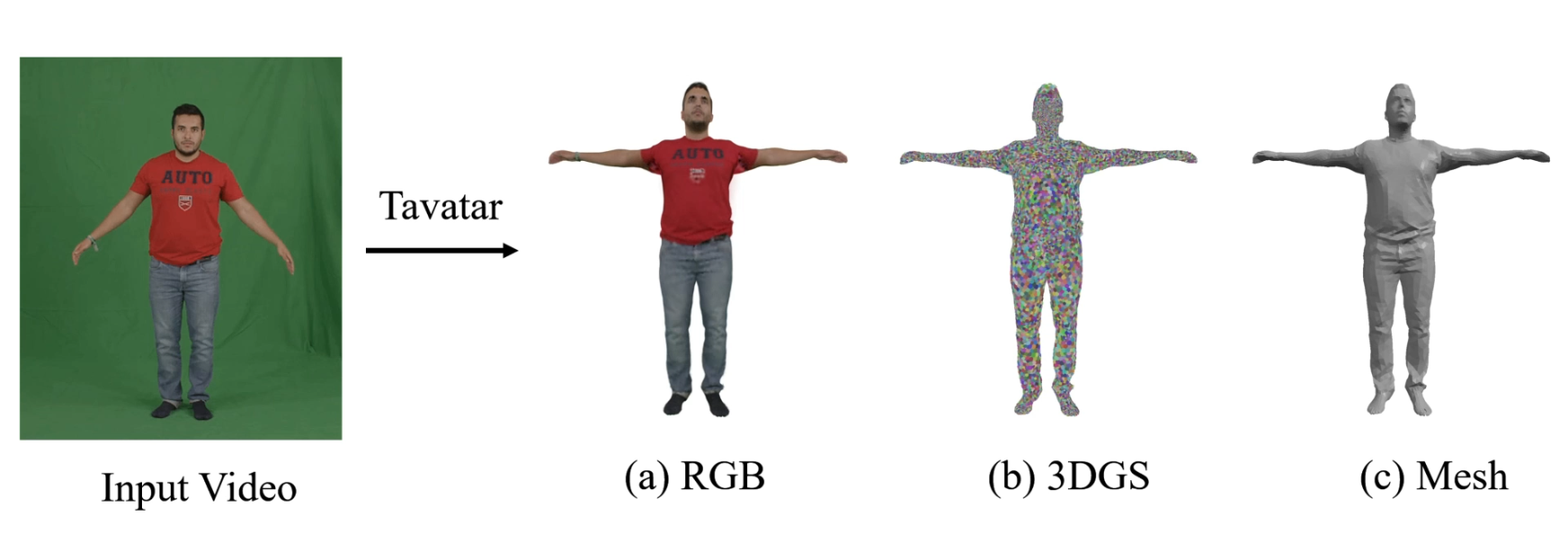
Tavatar: Topology-Aware Gaussian Attribute Derivation for Animatable Human Avatars

Hailin Luo1* , Yifan Yang4,5* , Jiazhi Shu1* , Zixiong Huang1 , Qi Chen2 , Qing Du1 , Mingkui Tan1,3
* Equal Contribution
1South China University of Technology     2Adelaide University     3Pazhou Lab
4Electric Power Research Institute, CSG     5Guangdong Provincial Key Laboratory of Power System Network Security
Preview image

⚠️ Rate Limit Exceeded

Please wait a few minutes and try again. You can also refresh the page to retry.

Our method constructs a topology-aware 3D Gaussian representation from monocular videos.

Interactive Demos

Compare methods side-by-side using the dual viewer interface. Select Method, Subject, and Pose from dropdowns. Enable Random Color for better 3DGS visualization.

Viewer Interactions: Use mouse to drag for rotation, scroll for zoom, and right-click + drag for panning.
Loading 3D Viewer...
🎮 In-Viewer Controls: Switch between 3DGS, Mesh, Mesh-Frame, and Combo display modes. Enable Auto Rotate for automatic camera rotation.
⏳ Resource Loading: Initial loading may take 30-60 seconds. A dedicated GPU is recommended for optimal performance.
🎨 GoM Limitation: GoM method uses an additional shading module that affects 3DGS color rendering, causing different visual appearance compared to other methods.
💻 Browser Recommendation: For best performance and compatibility, use Chrome browser on PC. Mobile devices may experience slower loading and reduced functionality.

Abstract

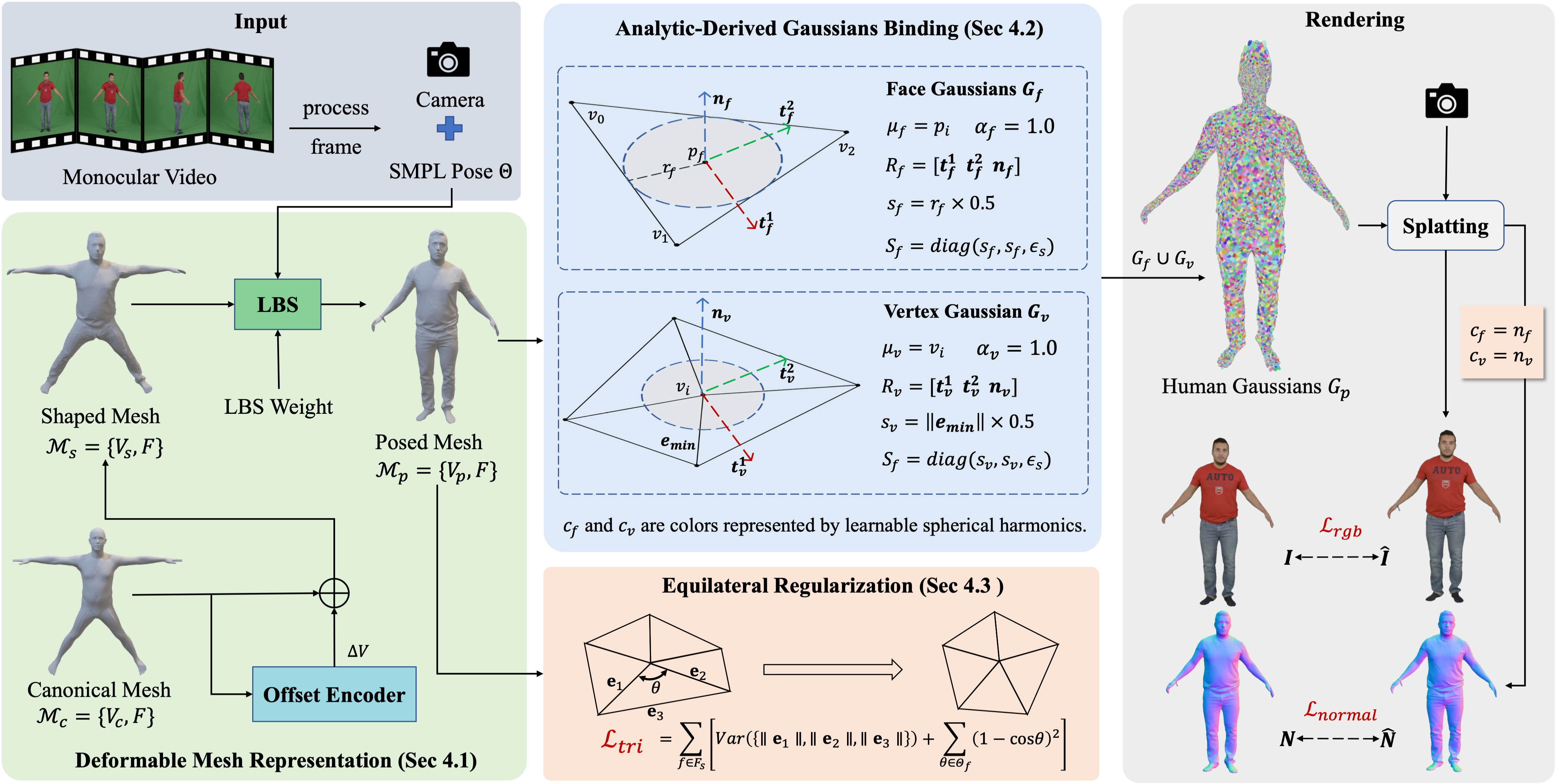
Reconstructing high-fidelity, animatable human avatars from monocular videos remains a critical challenge. Existing 3DGS-based human animation methods constrain Gaussian parameters but exclude scale, which we argue is crucial for adapting human poses to challenging out-of-distribution poses. To achieve robust animation under unseen poses, we propose Tavatar, which derives key parameters such as scale, rotation, and other geometric attributes directly from the local mesh geometry, instead of learning them through unconstrained optimization. This paradigm shift enforces topological consistency by design, as each Gaussian is analytically anchored to the local mesh geometry, inheriting its spatial structure and deformation behavior. Specifically, we bind Gaussians to mesh faces and vertices, deriving their scales and orientations from triangle properties and local edge lengths to ensure coherent surface coverage. To ensure the stability of this analytical mapping, we introduce a crucial equilateral regularization term that preserves mesh integrity. Extensive experiments demonstrate that Tavatar achieves superior animation robustness on challenging out-of-distribution poses, reducing normal error by 13.8% on X-Avatar and 17.9% on PeopleSnapshot against the best baseline, while maintaining competitive rendering quality.

Overview

Method overview. We propose Tavatar, a geometry-driven paradigm that reconstructs high-quality animatable human avatars by analytically deriving Gaussian attributes from a deformable mesh. Our approach includes: Analytical Gaussian Attribute Derivation: All Gaussian positions, scales, and orientations are computed directly from mesh topology—rather than optimized—yielding structurally correct Gaussian placement, improved surface coverage, and pose-consistent animation across challenging motions. Equilateral Geometry Regularization: An equilateral constraint enforces stable Gaussian binding on the mesh, preventing degeneration and ensuring robust reconstruction quality, especially under large deformations and in fine-detail regions such as hands and clothing folds.

Reconstruction Results

People Snapshot - Eval

People Snapshot - AIST Demo

X-Avatar - Eval

X-Avatar - AIST Demo